-1.png?width=1456&height=476&name=xtrm%20logo%20white%20on%20transparent%20(1)-1.png)
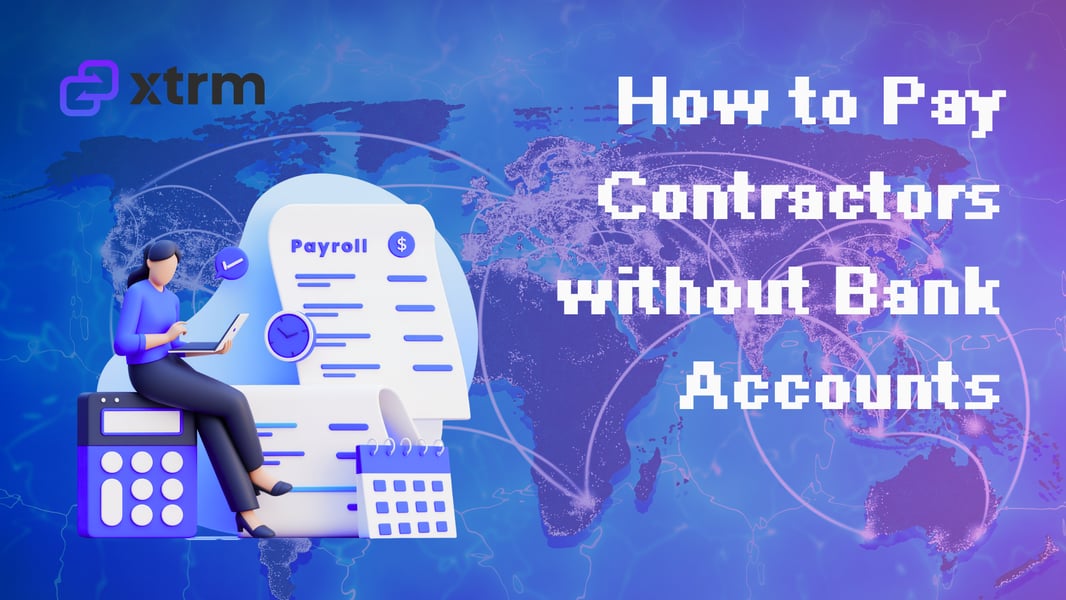
Global Contractor Payments: Non-Bank Payout Guide
Enterprise finance teams often assume that a traditional local bank account is a strict requirement for executing global contractor payments. When a valuable developer in South America or a top-performing channel partner in Southeast Asia requests an alternative payout method, financial workflows typically grind to a halt.
It is incredibly frustrating to watch high-value partner relationships stall over payment logistics. However, the reality of the modern global workforce is that traditional banking is not always the best, or even a viable, option for the recipient. Many international contractors and freelancers operate in regions where traditional bank transfers are subject to extreme currency volatility, massive intermediary fees, or significant delays.
When you distribute a $200 reward to a sales representative overseas, a $45 wire transfer fee completely destroys the intended motivation. To fix this, modern enterprises are deploying intelligent payout architectures that bypass legacy banking bottlenecks while keeping the organization fully compliant.
Establishing Global Tax Compliance Before the First Payout
The most dangerous misconception in enterprise finance is the belief that alternative payout methods bypass standard tax regulations. Whether you are sending funds to a traditional bank account or a digital wallet, global tax compliance remains exactly the same. You cannot skip regulatory checkpoints just because the payout method is digital.
For U.S. based organizations, payments made to independent contractors are classified strictly as non-employee compensation. To protect your enterprise from compliance violations, you must collect the correct documentation natively during the onboarding process. To manage this volume of data securely, ops leaders must understand what is a payee manager in enterprise payments and how centralized profiles keep tax documentation perfectly accurate across all transactions.
IRS Form W-8BEN vs. W-9
If you are paying a U.S. citizen or resident alien, you must collect a Form W-9.
If you are paying a foreign contractor, you are required to collect an IRS Form W-8BEN (for individuals) or a Form W-8BEN-E (for entities). This sworn document certifies their non-U.S. status and establishes their eligibility for international tax treaty benefits. Without this form on file before the first payment executes, your enterprise may be forced to apply a mandatory 30% backup withholding tax on their earnings.
Furthermore, your payout infrastructure must actively screen recipients against global watchlists maintained by regulatory bodies like the Financial Action Task Force (FATF). This ensures your incentive payment distribution does not inadvertently violate Anti-Money Laundering (AML) laws.
Alternative Methods for International Contractor Payouts
When you align your operations with modern recipient payout preferences, you quickly discover that empowering the payee with choice is the ultimate operational advantage. By utilizing a unified digital architecture, you can offer compliant, non-bank alternatives that meet your contractors exactly where they are.
Multi-Currency Digital Wallets
Digital wallets serve as a secure holding environment for your recipients. Instead of forcing a cross-border wire transfer, you can fund a contractor's digital wallet directly. The recipient can then hold the balance in multiple currencies, shielding themselves from daily exchange rate fluctuations, and disburse the funds on their own timeline.
Virtual Prepaid Cards
For contractors who need immediate purchasing power, virtual Visa or Mastercard prepaid cards are exceptional alternatives. The funds are available instantly upon approval, allowing the contractor to make online purchases or pay local utility bills without ever needing to route the money through a traditional local bank branch.
Digital Gift Cards
When managing channel marketing programs, you frequently need to issue micro-payments. Digital gift cards are an incredibly effective mechanism for smaller SPIFF payments and localized incentive rewards. Because they do not require bank routing numbers or SWIFT codes, they deliver instant gratification to the partner while remaining fully traceable for your finance team.
Automating the Approval and Execution Workflow
Offering flexible payment methods is only half of the operational equation. The other half involves ensuring your finance team maintains absolute control over the outflow of capital.
For enterprise teams researching how to fix bulk payment bottlenecks in 2026, the answer lies in connecting these alternative payment methods to an intelligent approval engine. This guarantees that a payout directed to a digital wallet or a virtual card undergoes the exact same contextual scrutiny as a traditional high-value wire transfer.
By setting contextual thresholds, you can automate low-value incentive payouts for immediate delivery while routing high-value contractor settlements to your CFO or regional managers for secondary authorization.
Solving Fragmentation With Unified Payout Infrastructure
The fastest way to destroy your finance team's efficiency is to manage one software platform for bank transfers, a separate vendor for virtual cards, and a third system entirely for digital gift cards. This disconnected approach creates a brutal reconciliation nightmare at the end of every month.
A unified platform consolidates funding, compliance verification, and multi-method execution into a single master ledger. You fund your enterprise account once in your base currency, and the infrastructure automatically handles the currency conversion and localized delivery based entirely on what the recipient chooses.
FAQs About Global Contractor Payments
How do you handle global contractor payments without a local bank account?
The most compliant and efficient way to pay international contractors without local bank accounts is by utilizing embedded digital wallets and virtual prepaid cards. These alternative methods provide the recipient with immediate access to their funds and purchasing power without relying on expensive, slow cross-border SWIFT transfers.
How does global tax compliance work for non-employee compensation?
Global tax compliance requires strict identity verification and documentation before any funds are transferred. For U.S. enterprises paying foreign contractors, you must collect an IRS Form W-8BEN (or W-8BEN-E) to certify their non-U.S. tax status and prevent mandatory 30% backup withholding on their non-employee compensation.
Can I issue SPIFF payments using digital gift cards?
Yes, digital gift cards are an excellent, compliant method for issuing SPIFF payments and localized channel rewards. Because they bypass traditional banking rails, they eliminate intermediary wire fees and deliver instant value to the recipient, provided the transactions are still logged centrally for accurate financial reconciliation.
Why is incentive payment distribution difficult across borders?
Incentive payment distribution becomes difficult globally due to fragmented banking systems, varying local compliance regulations, and extreme currency exchange fees. Using a unified mass payout platform solves this by centralizing the compliance checks and offering the recipient the freedom to choose their preferred local payout method.
Scale Your Global Operations with Xtrm
You no longer need to restrict your talent pool or alienate your top channel partners simply because they lack access to traditional banking infrastructure. By leveraging intelligent digital wallets and automated tax documentation, you can securely execute international contractor payouts anywhere in the world.
Xtrm provides enterprise finance and operations teams with a completely unified payment architecture. Through embedded KYC compliance, automated tax form collection, and absolute recipient payout choice, Xtrm transforms global compensation from an operational bottleneck into a massive competitive advantage.
Ready to streamline your contractor payments and eliminate cross-border friction? Discover how Xtrm automates compliance and delivers global payout choice. Contact the Xtrm team today to build a faster, more resilient payment ecosystem.
Jul 6, 2026, 10:16:24 AM
![[UPDATED] 2027 US Tax Filing Deadlines for Payout Teams](https://blog.xtrm.com/hs-fs/hubfs/The%202026%20US%20Tax%20Filing%20Deadlines.png?width=520&height=294&name=The%202026%20US%20Tax%20Filing%20Deadlines.png)
![[UPDATED] What Is a Form 1099-K? 2026 Thresholds and Who Gets One](https://blog.xtrm.com/hs-fs/hubfs/Imported_Blog_Media/What-is-a-1099-K-and-who-needs-it-1.jpg?width=520&height=294&name=What-is-a-1099-K-and-who-needs-it-1.jpg)