-1.png?width=1456&height=476&name=xtrm%20logo%20white%20on%20transparent%20(1)-1.png)

Why compare Xtrm vs Tipalti?
Businesses rely on a vast ecosystem of partners, vendors, and gig workers to drive growth. This scaling, however, brings a complex challenge: executing secure, compliant, and timely global payouts.
Whether you are running a large-scale channel partner program, managing incentive payments, or simply paying a global network of suppliers, the rising need for global payout automation is critical for speed and compliance.
Enter Xtrm and Tipalti, two of the top choices for building a secure and scalable payment infrastructure. While both platforms enable powerful mass payouts and global reach, they have fundamentally different core strengths. This guide will provide a neutral comparison to help you choose the right global payout platform for your organization.
Quick platform overview
Xtrm: The Intelligent Global Payout Platform
Xtrm is built as an intelligent global payments platform, focused specifically on high-volume, complex payout use cases like channel incentives, partner payouts, and rebates. Its differentiating feature is a connected multi-currency wallets architecture, which allows companies to aggregate funds and give recipients flexible choice in how they receive their money.
Xtrm offers robust API automation and supports a massive range of payout methods, providing strong global compliance (SOC 2 Type II, KYC, AML) and audit-ready reporting. Its focus is on making the payment experience seamless, transparent, and immediate for the recipient.
Tipalti: Accounts Payable and Mass Payment Automation
Tipalti operates primarily as a comprehensive Accounts Payable (AP) and mass payment automation platform. It is widely used by finance and accounting teams to streamline the entire supplier payment workflow—from vendor onboarding and tax compliance to invoice management.
Tipalti provides strong integrations with major ERP tools like NetSuite and QuickBooks, making it a powerful solution for centralizing and automating the entire accounts payable automation process. Its strength lies in managing vendor networks and mitigating financial risk.
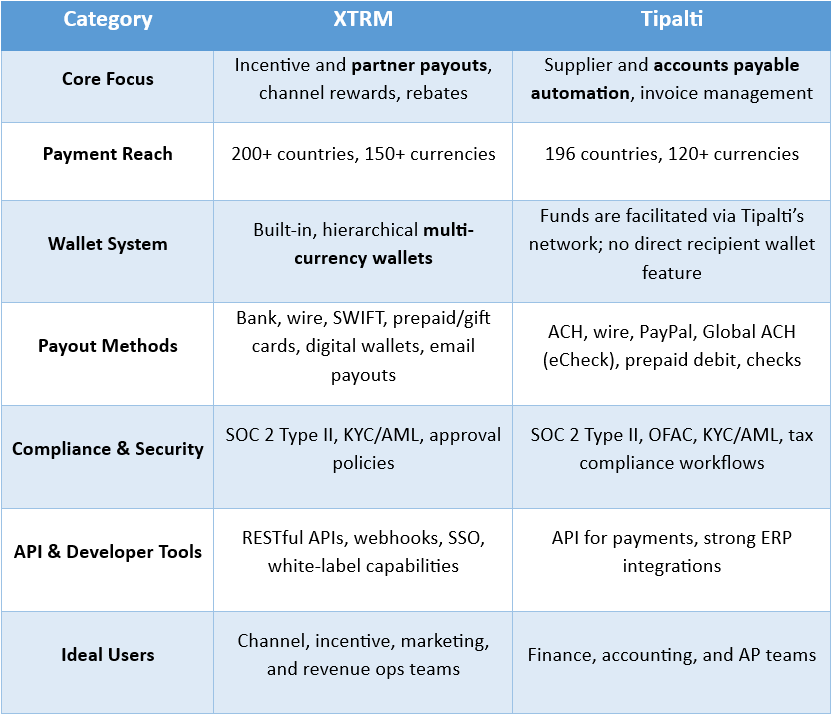
Table 1: Comparing the features between Xtrm and Tipalti
What your team needs: Xtrm vs Tipalti detailed breakdown
Global Coverage and Flexibility
Both platforms provide extensive global reach, supporting robust cross-border payments. Tipalti supports over 196 countries and territories and 120 currencies. Xtrm offers an even wider scope with 200+ countries and 150+ currencies.
The key difference lies in how recipients interact with their funds. Xtrm's unique multi-currency wallets system offers recipients significant payout flexibility. Funds are deposited into a secure, self-serve wallet, allowing the payee to choose their preferred method—whether it’s a direct bank transfer, a prepaid card, or a gift card—at their own pace. This wallet-based approach enhances the recipient experience for incentives and channel partners.
Tipalti, conversely, has a more bank-centric approach. It excels at ensuring funds are transferred accurately via ACH, wire, or other methods directly to the supplier's bank account, which is the traditional requirement for accounts payable automation.
Automation and API Integrations
For businesses that require deep, custom integration into their existing applications, Xtrm emphasizes its developer-friendly API integrations and white-label capabilities. Xtrm's platform and APIs allow for a fully embedded payment process, enabling users to manage funds, payouts, and compliance within their own application. This is particularly valuable for SaaS platforms and PRM systems looking to automate partner payouts directly.
Tipalti’s automation strength lies in its pre-built integrations with major Enterprise Resource Planning (ERP) systems like NetSuite, Microsoft Dynamics, and Sage Intacct. Tipalti's focus on payment automation simplifies complex finance workflows, but its front-end customization and embedded capabilities are more limited compared to Xtrm’s developer-first approach.
Compliance and Security
Both platforms prioritize compliance and security, offering SOC 2 Type II certification and automated KYC/AML checks. This is non-negotiable for any global payout platform.
- Tipalti → Excels at supplier-side compliance by automating W-9 and W-8 tax form collection and validation, essential for large-scale vendor management. Its compliance workflows are deeply tied to its AP automation features.
- Xtrm → Provides maker-checker logic, approval policies, and real-time auditing controls that are crucial for managing complex, multi-tiered incentive payments and channel rebates.
User and Recipient Experience
The user experience often defines where each platform shines.
- Tipalti’s recipient experience centers on the vendor portal. Suppliers use this portal to manage their invoices, track payment status, and upload required tax and payment information, which significantly reduces administrative work for the AP team.
- Xtrm focuses on providing superior payout flexibility and choice for the recipient. Recipients have real-time visibility into their earnings and can manage their funds through the self-serve wallet, which is essential for boosting engagement in SPIFF programs and partner channels.
Scalability and Speed to Value
While Tipalti is ideal for scaling large AP and vendor networks, Xtrm is designed for high-velocity, high-volume incentive payments and partner ecosystems. For companies that need to quickly stand up a global program, Xtrm can often be launched in days with prebuilt API templates, offering a fast speed to value.
Pricing and Implementation Considerations
Understanding the pricing model is essential for any mass payouts solution.
- Tipalti → Typically employs a modular pricing model based on the product features used (e.g., AP Automation, Mass Payments) and the volume of invoices or payments processed. Advanced features, like global multi-entity infrastructure or FX hedging, often require custom quotes.
- Xtrm → Generally prices based on transaction tiers and API usage. The platform is often cited for transparent, low-cost transaction fees for core payment methods, such as a low fee for sending funds to a wallet or via ACH. Implementation can be rapid due to the API-first, embedded architecture.
Which one fits your organization?
Choosing the right global payout platform depends on your core business function:
- Xtrm → The optimal choice for partner payouts, incentive payments, and businesses that rely on a global ecosystem of channel partners, contractors, or gig workers. If you need a white-labeled, API-embedded solution with superior recipient payout flexibility through multi-currency wallets, Xtrm is your best fit. Businesses running global MDF programs, SPIFFs, or loyalty rewards will benefit most from Xtrm's architecture.
- Tipalti → The better fit for companies primarily looking to solve traditional accounts payable automation. If your primary goal is vendor management, invoice tracking, ERP integration, and internal finance process streamlining, Tipalti's AP-centric features will be most beneficial.
Frequently asked questions about Xtrm and Tipalti
What is the main difference between Xtrm and Tipalti?
Xtrm focuses on recipient-centric incentive and partner payouts using multi-currency wallets and embedded APIs, while Tipalti focuses on supplier-side AP automation with deep ERP integrations for invoicing, tax capture, and vendor management.
Who should choose Xtrm?
Teams running global incentives, SPIFFs, rebates, and partner payouts that need wallet-based flexibility, recipient choice of payout method, and developer-first embedding are best served by Xtrm.
Who should choose Tipalti?
Finance and accounting teams seeking end-to-end AP automation—vendor onboarding, W-8/W-9 tax compliance, invoice processing, and ERP alignment—typically benefit most from Tipalti.
Do both platforms support global compliance and security?
Yes. Both emphasize security and compliance, including SOC 2 Type II and KYC/AML controls. Tipalti’s workflows center on supplier tax and AP processes, while Xtrm adds maker-checker approvals and audit trails for incentive and partner payouts.
How do payout methods compare between Xtrm and Tipalti?
Xtrm's wallet-driven model enables bank transfers, prepaid and gift cards, digital wallets, and email payouts, giving recipients choice and timing flexibility. Tipalti emphasizes bank-centric options like ACH, wire, PayPal, Global ACH (eCheck), and checks.
Future-ready payments with Xtrm
Both Xtrm and Tipalti are powerful platforms that enable compliant cross-border payments and global finance management. However, the key distinction is in their purpose-built architecture.
Xtrm distinguishes itself by focusing on the recipient experience and developer extensibility. With its real-time multi-currency wallets and unparalleled payout flexibility, Xtrm simplifies global incentive payments and channel partner rewards. For organizations looking for a future-ready, API-first approach to turn their incentive programs into a growth engine, Xtrm is the clear leader.
Explore how Xtrm can simplify your global incentive payments and partner payouts. Book a call with our sales team today.

![What is the maker-checker process? How dual approval works [UPDATED]](https://blog.xtrm.com/hs-fs/hubfs/xtrm-hero-maker-checker.jpg?width=520&height=294&name=xtrm-hero-maker-checker.jpg)