-1.png?width=1456&height=476&name=xtrm%20logo%20white%20on%20transparent%20(1)-1.png)
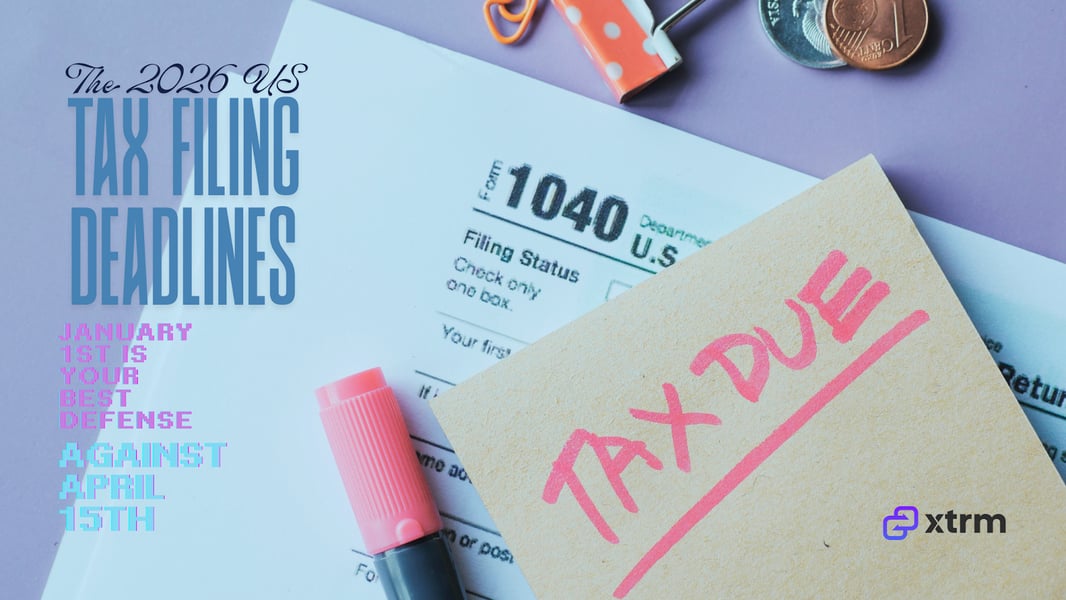
The date everyone remembers is April 15. For anyone who pays contractors or partners, the one that matters is February 1.
Most tax calendars are written for people filing their own returns. Payout teams live on a different schedule. If your company pays contractors, partners, or reward recipients, your obligations land in the first weeks of the year, and the hardest one arrives on the first business day of February, when Form 1099-NEC is due to every recipient and to the IRS on the same day.
The 2027 season also brings two firsts. It is the first filing season under the $2,000 reporting threshold for payments made in 2026, and the first since the IRS retired its older FIRE system, leaving IRIS as the only way to e-file information returns with the IRS. Both change what you need to do this fall, not in January.
Key takeaways
- Form 1099-NEC is due February 1, 2027 to recipients and the IRS, because January 31 falls on a Sunday. There is no later IRS date for this form.
- These are the first forms under the $2,000 threshold, which applies to payments made in 2026.
- FIRE is retired for tax year 2026 returns. The Information Returns Intake System is the only way to e-file information returns with the IRS this season.
- Backup withholding has its own return. Form 945 is due February 1, or February 10 if every deposit was made on time and in full.
- Paper filing only works for small filers. Ten or more information returns in total, counting W-2s, have to be filed electronically.
The 2027 deadline calendar at a glance
Every date below covers payments made during 2026. When a due date lands on a weekend or legal holiday, the IRS moves it to the next business day, according to its Guide to Information Returns, which is why several familiar deadlines shift this year.
| Date | What is due | Who it applies to |
|---|---|---|
| Friday, January 1 | Xtrm 1099-K and transaction CSV available to download | US Xtrm account holders |
| Monday, February 1 | Form 1099-NEC to recipients and the IRS | Businesses that paid contractors |
| Monday, February 1 | Forms 1099-MISC and 1099-K to recipients | Payers and payment settlement entities |
| Monday, February 1 | Form 945 for backup withholding | Payers who withheld during 2026 |
| Wednesday, February 10 | Form 945, if every deposit was made on time and in full | Payers who withheld during 2026 |
| Monday, March 1 | Paper Forms 1099-MISC and 1099-K to the IRS | Filers with fewer than 10 returns in total |
| Wednesday, March 31 | Electronic Forms 1099-MISC and 1099-K to the IRS | E-filers |
| Thursday, April 15 | Individual federal returns | Your recipients, not you |
Two things that are different this season
The first forms under the $2,000 threshold
For payments made on or after January 1, 2026, a 1099-NEC, or a 1099-MISC for payments such as prizes, awards, and rents, is required only once a payee's total for the year reaches $2,000, up from the $600 figure that stood for decades. That means fewer forms. The catch is that the old number still turns up everywhere: in software defaults, in old spreadsheets, in the instructions a colleague saved three years ago. Check yours before you rely on them. We cover the full change, including what it does not change, in our guide to the 2026 1099 threshold.
FIRE is retired, and IRIS is the only door
IRS Tax Topic 801 says the FIRE system is retired for tax year 2026, meaning the returns filed in 2027, and that the Information Returns Intake System becomes the only intake system for information returns from that filing season on. If your team or your filing vendor has used FIRE for years, this is the item to confirm now.
IRIS offers a free taxpayer portal that takes manual entry or a CSV upload, plus an application-to-application channel for software. Either route needs an IRIS Transmitter Control Code, and approval is not instant, so apply this fall rather than the week before the deadline. If you use a filing vendor, ask them directly whether they have moved. Most will have. It is a two-minute email that prevents a very bad week in January.
The form that allows no slack: 1099-NEC
Most information returns come with two deadlines: one for the recipient copy and a later one for the IRS. Form 1099-NEC does not. Both copies are due the same day, February 1 this year, whether you file on paper or electronically. That compresses the whole job into January: confirm every payee's details, total what each one received, and file.
The threshold change can also bite in the other direction. A payee who stayed under $600 in past years was easy to ignore. A payee who crossed $2,000 through a stack of small rewards in December is easy to miss. Totals have to be per person, across every program that paid them, which is exactly the trap a year-end incentive rush sets.
Backup withholding and Form 945
When a payee's taxpayer identification number is missing or wrong, a payer generally has to withhold 24% of reportable payments and send it to the IRS. That withholding has its own annual return, Form 945, due February 1, 2027, or February 10 if every deposit was made on time and in full, as the IRS sets out in its backup withholding reminder. And once you backup withhold on a payment, you have to file a 1099 for that payee even if their total falls below the normal threshold.
The cheaper fix is upstream. Collecting a correct Form W-9 before the first payment removes the most common trigger, a missing or mismatched taxpayer identification number.
Where Xtrm's January 1 data fits
On Xtrm, the year's tax documents do not wait for the IRS calendar. Every US account's 1099-K is available to download from January 1 in the account's Tax section, alongside a per-transaction CSV showing exactly which payments were counted. Xtrm provides one to every US person and company regardless of earnings, and the IRS reporting threshold for Xtrm is $20,000 and 200 transactions for goods and services received in the calendar year. Our Form 1099-K guide explains what the form reports and how it differs from a 1099-NEC.
Access requires a complete profile, so the fastest way to be ready on January 1 is to make sure payees finish their identity details in December. On the payer side, Xtrm collects W-9 and W-8BEN(-E) equivalent information when a payee is created, alongside automated KYC and AML checks, so the details your January filing depends on exist before the first payment moves. Payment and foreign exchange transactions are powered and provided by Corpay.
A countdown for payout teams
- October: Confirm your filing route. If you used FIRE, move to IRIS and apply for a Transmitter Control Code now.
- November: Chase missing or suspect taxpayer identification numbers while payees still have payments coming and a reason to reply.
- December: Confirm your payment provider's year-end cutoff, because the payment date decides which tax year a payout falls in.
- January 1 to 15: Pull the year's data and total payments per payee across every program.
- February 1: File 1099-NEC with the IRS, send all recipient copies, and file Form 945 if you withheld.
- March 31: File electronic 1099-MISC and 1099-K returns with the IRS.
FAQs about the 2027 tax filing deadlines
When are 1099s due in 2027?
For payments made in 2026, Form 1099-NEC is due to recipients and the IRS on Monday, February 1, 2027, because January 31 falls on a Sunday. Forms 1099-MISC and 1099-K are due to recipients the same day, with IRS copies due March 1 on paper or March 31 if filed electronically.
Can we still file 1099s through FIRE in 2027?
No. The IRS has retired FIRE for tax year 2026 returns, the ones filed in 2027, and IRIS is the only intake system for information returns filed with the IRS. You can file through the free IRIS Taxpayer Portal or through software that connects to IRIS, and either route needs an IRIS Transmitter Control Code.
Does the $2,000 threshold apply to forms filed in 2027?
Yes. The $2,000 threshold for Form 1099-NEC, and for 1099-MISC payments such as prizes, awards, and rents, applies to payments made in 2026, so the forms filed in early 2027 are the first under it. Forms filed in early 2026, covering 2025 payments, used the old $600 figure.
What happens if a tax deadline falls on a weekend?
It moves to the next business day. That is why the usual January 31 deadline becomes February 1 in 2027, and the paper filing date for Forms 1099-MISC and 1099-K moves from February 28 to March 1.
Conclusion: February 1 is the real deadline
April 15 gets the attention, but for anyone running payouts, the season is decided by what is ready on February 1: correct taxpayer details, one total per payee, and a filing route that works now that FIRE is gone. Almost all of it happens in the fall, which is the uncomfortable part. By January there is very little left you can fix.
If you want the tax record for every payee built into the payment flow before January arrives, we are glad to walk through how that works against your current process.
Last updated: September 27, 2026
Sep 26, 2026, 5:28:56 PM

![What is the maker-checker process? How dual approval works [UPDATED]](https://blog.xtrm.com/hs-fs/hubfs/xtrm-hero-maker-checker.jpg?width=520&height=294&name=xtrm-hero-maker-checker.jpg)