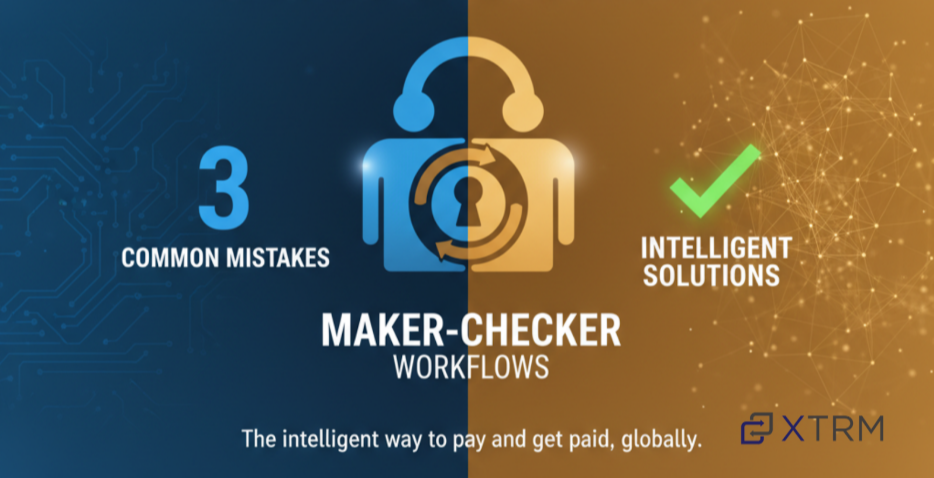
3 Common Mistakes That Sabotage Your Maker-Checker Workflows
In global finance, speed and security must stay in balance. That’s why maker-checker workflows have become a fundamental dual-approval system for businesses of all sizes—a simple concept where one person (the "maker") initiates a transaction, and a second (the "checker") verifies and approves it.
The intent is clear: to ensure financial control and to protect against human error and fraud. Yet even with the best intentions, many teams misconfigure these vital systems—creating unnecessary risk or crippling inefficiency. To make your operations smarter, let’s examine three common mistakes in setting up maker-checker workflows—and, more importantly, how to avoid them.
Mistake 1: Treating Maker-Checker as Just a Formality
Some organizations adopt a maker-checker system only because they feel required to, turning it into a rubber-stamp exercise instead of a real safeguard. The problem arises when the "checker" role goes to someone in the same functional group as the "maker"—or worse, when the system automatically approves without genuine oversight.
This setup creates a false sense of security, undermines accountability, and violates the principle of the segregation of duties. Errors and fraud risks slip through when people effectively approve their own actions.
To keep the process simple and effective, assign independent approvers to the "checker" role and establish clear lines of authority. True control demands intentional, independent oversight. For a practical example of this, explore Xtrm's maker-checker process.
Mistake 2: Overcomplicating the Workflow
When workflows become too rigid or include too many steps, delays, bottlenecks, and frustrated employees quickly follow. If payment approvals pass through five people and two departments for a standard transaction, employees start looking for shortcuts—or ignore the process altogether.
The result is a slow, complex system that people bypass, leaving financial controls and security exposed. A smarter approach keeps the process simple and role-based.
Approval policies should enhance operations, not block them. Set clear thresholds based on payment amount and risk level. For example, a small payment may only require a basic maker-checker pairing, while larger transactions may call for a higher-level approver.
This tailored approach becomes especially important when managing specialized payment types such as SPIFF programs. Incentive payments must move quickly and accurately, but they also require oversight. An overly rigid workflow destroys the speed these programs need.
A smarter solution applies unique, high-efficiency maker-checker workflows built specifically for your SPIFF program, ensuring fast delivery while maintaining full segregation of duties and control.
Mistake 3: Ignoring Automation and Audit Trails
Manual checks, such as emails or spreadsheets, waste time and create risk. Informal approval channels erase the paper trail you need for compliance. Without clear records, errors stay hidden, accountability disappears, and you lack an audit trail during reviews.
For strong fraud prevention, your system must automatically record every step of the approval process. Platforms like Xtrm make this simple. Xtrm enforces approval policies through automated workflows and generates a detailed, time-stamped log for every transaction. This built-in transparency forms the backbone of modern financial controls.
Frequently Asked Questions on Maker-Checker Workflows
What happens if maker-checker is treated as just a formality?
It undermines accountability and segregation of duties, creating risks of errors and fraud.
Why does overcomplicating maker-checker workflows cause problems?
Too many steps cause bottlenecks and delays, which push employees to bypass the system and compromise security.
Why is automation important in maker-checker workflows?
Automation enforces approval policies, reduces manual errors, and creates a clear audit trail for compliance and fraud prevention.
Ready to Optimize Your Controls?
Effective maker-checker workflows aren’t about adding friction. They’re about establishing real oversight, driving efficiency, and keeping you audit-ready at all times. By avoiding three pitfalls—treating oversight as a formality, overcomplicating workflows, and neglecting automation—you create a system that is both secure and operationally smarter.
Ready to design approval policies that are dynamic, flexible, and fully traceable? Learn how Xtrm embeds Maker-Checker policies directly into payment flows, balancing security with speed. For a more intelligent and secure approach to global payments, explore Xtrm's security features today.
Effective financial controls don’t have to slow you down. Take the next intelligent step with Xtrm's dynamic maker-checker process.
-1.png?width=1456&height=476&name=xtrm%20logo%20white%20on%20transparent%20(1)-1.png)

![What Is the Maker-Checker Process? How Dual Approval Works [UPDATED]](https://blog.xtrm.com/hs-fs/hubfs/xtrm-hero-maker-checker.jpg?width=520&height=294&name=xtrm-hero-maker-checker.jpg)