-1.png?width=1456&height=476&name=xtrm%20logo%20white%20on%20transparent%20(1)-1.png)

Measuring MDF ROI turning spend into verifiable partner growth
The challenge of MDF ROI
In the world of B2B channel sales, few strategic investments are as vital—or as consistently difficult to measure—as Market Development Funds (MDF).
Market Development Funds are resources that brands allocate to their channel partners to support co-marketing, demand generation, or enablement activities. They are intended to extend the reach of the brand, accelerate sales cycles, and build deeper partner relationships.
However, despite their clear potential, MDF often suffers from poor visibility and unmeasured impact. In many organizations, MDF is treated like an unavoidable cost center, with little reliable ROI reporting to justify the expense.
This article will shift that perspective, demonstrating how to turn your MDF program from an opaque cost into a measurable growth lever by focusing on calculating and maximizing MDF ROI.
If you’re new to MDF, explore our Market Development Funds 101 resource to get up to speed.
Understanding MDF ROI
The first step in effective management is defining success. MDF ROI (Market Development Fund Return on Investment) is the metric that quantifies the financial benefit generated by a partner's MDF-funded activity relative to the original MDF spend.
Unlike traditional direct marketing ROI, measuring MDF ROI presents unique complexities. Since the partner is the one executing the campaign, your organization must track indirect impact and partner-driven metrics, not just direct conversions.
True ROI requires a unified system that connects the initial funding request, the subsequent MDF spend, the partner’s execution data, and the resulting closed revenue or measurable sales influence. By mastering this, you can accurately assess MDF performance.
The formula: How to calculate MDF ROI
To successfully measure MDF ROI, you need a standardized formula and a clear understanding of attribution.
The basic ROI formula is:
ROI = (Attributed Revenue − MDF Spend) ÷ MDF Spend × 100
- Attributed Revenue is the measurable revenue that was directly influenced by the MDF activity (e.g., a lead generated by a partner's funded event that closed into a sale).
- MDF Spend is the total amount of funds allocated and claimed by the partner for that specific activity.
Example: If a partner’s MDF spend was $10,000 and the activity led to $40,000 in Attributed Revenue, the ROI is 300%:
ROI = (40,000 − 10,000) ÷ 10,000 × 100 = 300%
The challenge is often less about the math and more about attribution. You must track not just direct conversions, but also the influence the MDF activity had on pipeline creation or brand lift. This holistic approach is essential for calculating an accurate incentive program ROI.
Key metrics that define MDF ROI
A high-level ROI percentage is necessary, but the underlying metrics reveal the story of MDF performance. These metrics help you evaluate the success of a campaign and optimize your future funding decisions.
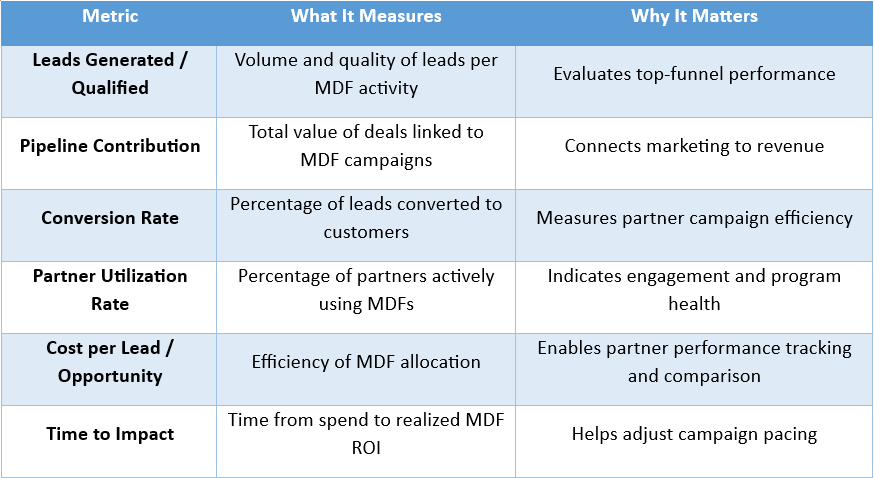
Table 1: Key metrics that define MDF ROI
Common barriers to measuring MDF ROI
Despite clear formulas and key metrics, many organizations struggle to measure MDF ROI accurately.
These are some of the most common obstacles to achieving a high partner marketing ROI:
Lack of Consistent Partner Reporting
Partners submit reports in disparate formats, making it impossible to aggregate and analyze data uniformly.
Generic Fund Usage
MDF is often used for broad activities—like sponsoring an event—with no clear mechanism to track the resulting leads or sales attribution.
Fragmented Tools
Data is siloed across different systems: email platforms, CRM, and payout systems are not connected.
Overreliance on Self-Reported Data
Relying solely on a partner's self-reported data without a validation or AN audit trail leads to inaccurate ROI reporting.
To navigate these issues, it’s helpful to understand the larger challenges in MDF management.
How to improve measurement: Process, technology, and governance
To move past the common barriers, companies must strategically integrate process, technology, and governance.
Improving MDF management and measurement effectiveness requires focused strategic changes:
Standardize Reporting and Proof of Performance (POP)
Before funds are allocated, define the exact metrics (Leads, Opportunities, Registrations) and the required Proof of Performance documentation (invoices, attendee lists, campaign URLs) that must accompany a claim. This standardization across all partners is non-negotiable and makes aggregated ROI reporting possible.
Integrate Financial and CRM Data
The most significant measurement improvement comes from connecting the payout platform (where MDF spend is recorded) directly to the CRM (where sales and pipeline data reside).
This link provides the essential attribution trail needed to accurately calculate the true incentive program ROI. Look for systems that can automate this data exchange, eliminating manual cross-referencing and tracking.
Implement Tiered Performance Audits
High-value partners or those running significant campaigns should undergo stricter verification. By actively reviewing campaign data and ensuring the reported outcomes align with closed deals in your CRM, you establish a necessary culture of accountability and significantly improve the reliability of your partner performance data.
Platform solutions: Xtrm's role in modern MDF ROI
The complexity of modern global channels demands a dedicated technological solution to unify the entire process. Platforms like Xtrm specialize in transforming fragmented MDF workflows into a streamlined, high-visibility operation that ensures accurate ROI measurement.
How Xtrm elevates MDF measurement:
- Unified Payout and Tracking: The Xtrm platform is designed to link the funding, the claimed expense, and the resulting performance metrics in a single interface. This eliminates the silo between finance and channel marketing, providing a single source of truth for all MDF ROI data.
- Automated Compliance and Audit Trails: By requiring specific, digital Proof of Performance before funds are disbursed, Xtrm forces standardization, drastically reducing administrative overhead and the risk of non-compliant claims. This ensures that every dollar of MDF spend is verifiably tied to a measured activity.
- Global Scalability: For companies operating a global channel, a system like Xtrm manages multi-currency payouts and local compliance, ensuring that your partner marketing ROI is measured consistently and reliably across all territories without unnecessary manual effort.
By leveraging a platform like Xtrm, organizations can shift their focus from administrative tracking to strategic optimization, using accurate, real-time data to decide which partners and activities warrant the next round of funding.
Best practices for sustained partner growth
Effective MDF measurement is not a one-time event; it's a continuous cycle of funding, execution, measurement, and optimization.
To maintain a high MDF ROI and foster a thriving channel ecosystem:
Fund Outcomes, Not Activities
Shift your MDF program design to reward partners based on realized results (e.g., pipeline created, qualified leads generated, new certifications earned) rather than simple activity completion. This focuses funding on activities that demonstrably increase sales.
Share the Data
Provide partners with their own partner performance data and ROI results.
When partners understand which campaigns yield the highest incentive program ROI, they are more likely to repeat successful strategies, creating a virtuous cycle of growth and aligning their goals with yours.
Align MDF with the Partner Ecosystem Strategy
MDFs should be viewed as a tool to activate and advance partners within your cross-border MDF programs in a broader partner ecosystem.
Successful MDF programs integrate seamlessly with the overall strategy for managing all partner types, from resellers and solution providers to referral agents.
Your next steps: Building a high-ROI, data-driven MDF strategy
Measuring MDF ROI effectively is the difference between a high-cost program and a high-impact growth engine.
By defining attribution clearly, standardizing reporting, integrating data systems, and leveraging purpose-built platforms like Xtrm, you can gain the visibility needed to justify your investment, optimize your channel strategy, and scale the activities that truly drive success through your channel partners.
Depending on your organization’s standards, you may calculate ROI using Attributed Revenue or Attributed Gross Margin. For financially rigorous MDF programs, margin-based ROI is often more accurate.
Explore how your business can build a more data-driven, high-ROI MDF program. Book a call with our sales team today.

![What is the maker-checker process? How dual approval works [UPDATED]](https://blog.xtrm.com/hs-fs/hubfs/xtrm-hero-maker-checker.jpg?width=520&height=294&name=xtrm-hero-maker-checker.jpg)